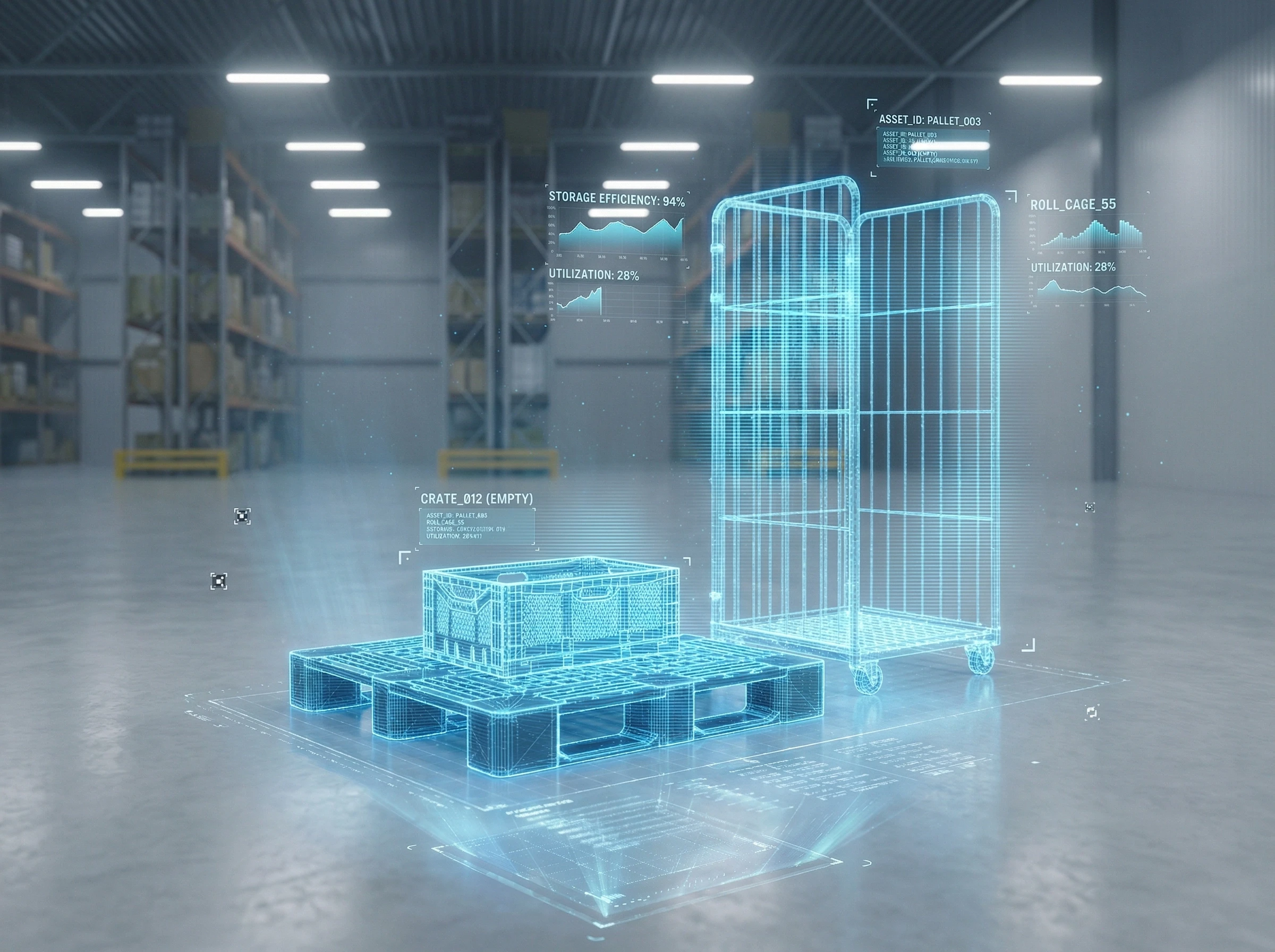
At the recent IntraLogisteX exhibition, Carl McInerney, Commercial Director UK&I at Connected Load Carrier, delivered a compelling session on a structural flaw haunting modern supply chains: the moment goods move between organizations, their information disappears.
In the semimar we explored why traditional collaboration often fails to scale and how the physical assets we often ignore (pallets, crates and containers, etc.) hold the key to a digital revolution.
The reset at the handover
We live in an era of margin pressure and volatile demand. But while tightening regulations like the PPWR force us to rethink our operations, efficiency still hits a brick wall at the warehouse door. Regardless of what’s written in our collaborative contracts and shared KPIs.
"Every time a pallet or a roll cage moves from producer to haulier, or DC to store, the information resets," Carl explained. "The asset moves, but the context doesn't. When the context resets, someone has to reconcile, someone has to buffer, and someone has to dispute."
This lack of continuity leads to:
Excessive safety stock: Cash tied up in inventory, just in case.
Manual reconciliation: Hours wasted chasing missing assets and correcting errors.
Strained relationships: Disputes between partners over who had what and when.
Lessons from the past
Carl shares a powerful story from his career to illustrate how breaking down silos creates massive commercial value. Years ago, he helped orchestrate a move to embed a physical planner directly inside a major retailer’s office to solve the headache of seasonal demand spikes.
While the planner still used two separate laptops for two separate systems, they operated from one shared version of the truth. By seeing the retailer’s inventory levels and promotion schedules in real-time, the planner could adjust supply before the typical seasonal spikes even happened. The result spoke for itself: they smoothed demand so effectively that a planned new distribution centre was no longer needed.
"Shared visibility reduces friction," Carl noted. "But today, we need to scale that principle beyond two companies to entire ecosystems. We can’t put a human planner in every building, we need a digital solution."
The load carrier: the only physical constant
If ERPs, WMSs and TMSs don't talk to each other across company lines, what does?
The load carrier.
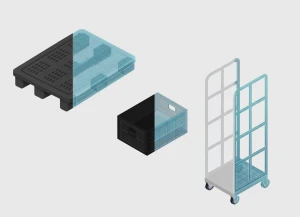
Load carriers like pallets, roll cages and containers are the only physical constants that touch every organization in the chain. Carl argues that treating these as mere costs to be counted is a missed opportunity. By giving these assets a Digital Twin, their history: dwell time, location and status travels with them.
"Digitalization isn't a simple reporting tool, it's infrastructure. When assets speak a common language, the economics change. Buffers shrink because uncertainty shrinks." Carl.
A practical path to ecosystem transformation
For businesses feeling the weight of coordination errors, Carl offered a strategic roadmap to move from cuddling hardware to releasing real business value:
Identify the friction: Don’t try to fix the whole ecosystem at once. Ask: Where are we losing control? Where are we reconciling manually?
Select a high-value asset group: Choose a specific group of assets (e.g., premium containers or high-turnover cages).
Secure asset identity: Use technology (RFID, powered, or non-powered sensors) to establish identity at key handover points.
Measure and scale: Once you see the rotation speed increase and the disputes drop, scaling becomes a data-backed business decision.
The bottom line
Connected Load Carrier’s approach isn't about replacing existing systems. It’s about providing the connection between them.
Connected Load Carrier integrates fragmented data streams from several stakeholders to create a shared operational truth. Here it’s not about replacing existing systems, but about unlocking the hidden value already sitting within them.
"Collaboration only becomes an advantage when it produces shared operational certainty," Carl concluded. When facts are no longer debated, handovers trigger action instead of arguments.
Ready to make collaboration create real operational certainty in your supply chain?